Day 5: Wrapping Up and Professional Development
Synthesizing your learning and looking ahead to your career.
Recap & Connection
A person pushing a large boulder, symbolizing the strategic effort required for Agile adoption and overcoming organizational challenges.
Welcome to our final day! Yesterday, we moved from team-level execution to organizational strategy. Today, we'll synthesize everything you've learned. Let's quickly review the key strategic concepts from Day 4:
- The Expanded Iron TriangleThe modern view of project constraints, including not just Scope, Time, and Cost, but also Quality, Resources, and Risk.
- Value-Driven DeliveryPrioritizing work based on the business value it delivers, using tools like the Value Roadmap to guide strategy.
- Agile Adoption & Change AgencyThe challenges of introducing Agile into an organization and the role of the Scrum Master as a change agent.
- Agile KPIs & MetricsMeasuring success with outcome-focused metrics like Cycle Time, Defect Density, and Customer Satisfaction.
- Scaling Agile FrameworksAn introduction to frameworks like SAFe, LeSS, and Nexus, which are used to apply Agile principles across multiple teams.
Course Conclusion

A person in a graduation cap looking out over a bright, sunlit landscape, symbolizing the future opportunities unlocked by completing the course.
Congratulations on completing this intensive week! You've journeyed from the foundational principles of Agile to the practical application of ScrumAn Agile framework that helps teams structure and manage their work through a set of values, principles, and practices. and KanbanA visual system for managing work as it moves through a process, focusing on flow and limiting work in progress.. Today, we'll synthesize this knowledge, explore different career paths, and prepare you to translate your new skills into professional opportunities.
Reviewing Key Learning Outcomes
A stylized checklist with key concepts, each with a checkmark, symbolizing the key learning outcomes of the course.
Over the past four days, we have built a strong foundation in modern project management. Let's quickly review the core skills you've developed. You can now:
- Agile vs Traditional
- Distinguish between traditional and Agile methodologiesTraditional (Waterfall) is a linear, sequential approach, while Agile is an iterative, flexible approach focused on continuous feedback and value delivery..
- Uphold the five Scrum ValuesThe five core values of Scrum: Commitment, Courage, Focus, Openness, and Respect, which provide a moral compass for the team's behavior. as the foundation for team behavior.
- Build and manage a Product BacklogThe Product Backlog is the single source of truth for all work. It's broken down into large Epics and then into small, user-focused User Stories. using the INVEST modelA set of criteria for creating effective User Stories: Independent, Negotiable, Valuable, Estimable, Small, and Testable. for User StoriesA short, simple description of a feature told from the perspective of the end user or customer..
- Visualize workflow and apply WIP LimitsA core practice in Kanban where the number of active items in a workflow state is limited to prevent bottlenecks and improve flow. using KanbanA visual system for managing work as it moves through a process, focusing on flow and limiting work in progress..
- Facilitate the five Scrum eventsThe time-boxed events in Scrum (Sprint, Planning, Daily Scrum, Review, Retrospective) that create regularity and enable inspection and adaptation. and uphold the Definition of DoneA formal, shared understanding of all the criteria that a User Story must meet before it can be considered complete, ensuring quality..
- Implement value-driven delivery using a Value RoadmapA strategic document that prioritizes work based on the business value it delivers, rather than on features and dates..
- Apply servant leadershipA leadership style where the leader focuses on the needs of the team, empowering them and removing impediments to help them achieve their goals. to coach an Agile teamA cross-functional group of individuals that can self-organize to complete work and deliver value iteratively. effectively.
Deep Dive: Lean Principles
A classic flow chart showing waste (represented by discarded items) being pulled out at each stage of a production process, illustrating the core Lean principle of eliminating waste.
LeanLean is a way of thinking about creating needed value with fewer resources and less waste. is a philosophy that has heavily influenced Agile and KanbanA visual system for managing work as it moves through a process, focusing on flow and limiting work in progress.. The core idea is to maximize customer value while minimizing waste. There are eight types of waste in Lean, including defectsProducts or services that are out of specification and require rework or are scrapped., overproductionProducing more of a product or feature than is needed at the moment., waitingIdle time created when a task has to wait for a dependency to be resolved., and unused talentFailing to make use of the skills, knowledge, and creativity of the team members.. By identifying and eliminating waste, teams can improve their efficiency, reduce costs, and deliver more value to the customer.
Other Frameworks: XP, Crystal, DSDM
A toolbox filled with specialized tools, each representing a distinct project management framework like XP, Crystal, and DSDM, symbolizing there are different tools for different jobs.
While ScrumAn Agile framework that helps teams structure and manage their work through a set of values, principles, and practices. and KanbanA visual system for managing work as it moves through a process, focusing on flow and limiting work in progress. are the most popular Agile frameworks, there are many others. Extreme Programming (XP)Extreme Programming (XP) is an agile software development framework that aims to produce higher quality software, and higher quality of life for the development team. focuses on technical excellence with practices like pair programming. CrystalCrystal is a family of agile software development methodologies that focus on people, interaction, community, skills, talents, and communication. is a family of methodologies tailored to the team's specific needs. DSDMThe Dynamic Systems Development Method (DSDM) is an agile project delivery framework, primarily used as a software development method. is well-suited for projects with tight deadlines. The key takeaway is that Agile is a spectrum of practices, not a one-size-fits-all solution.
The Agile Career Path
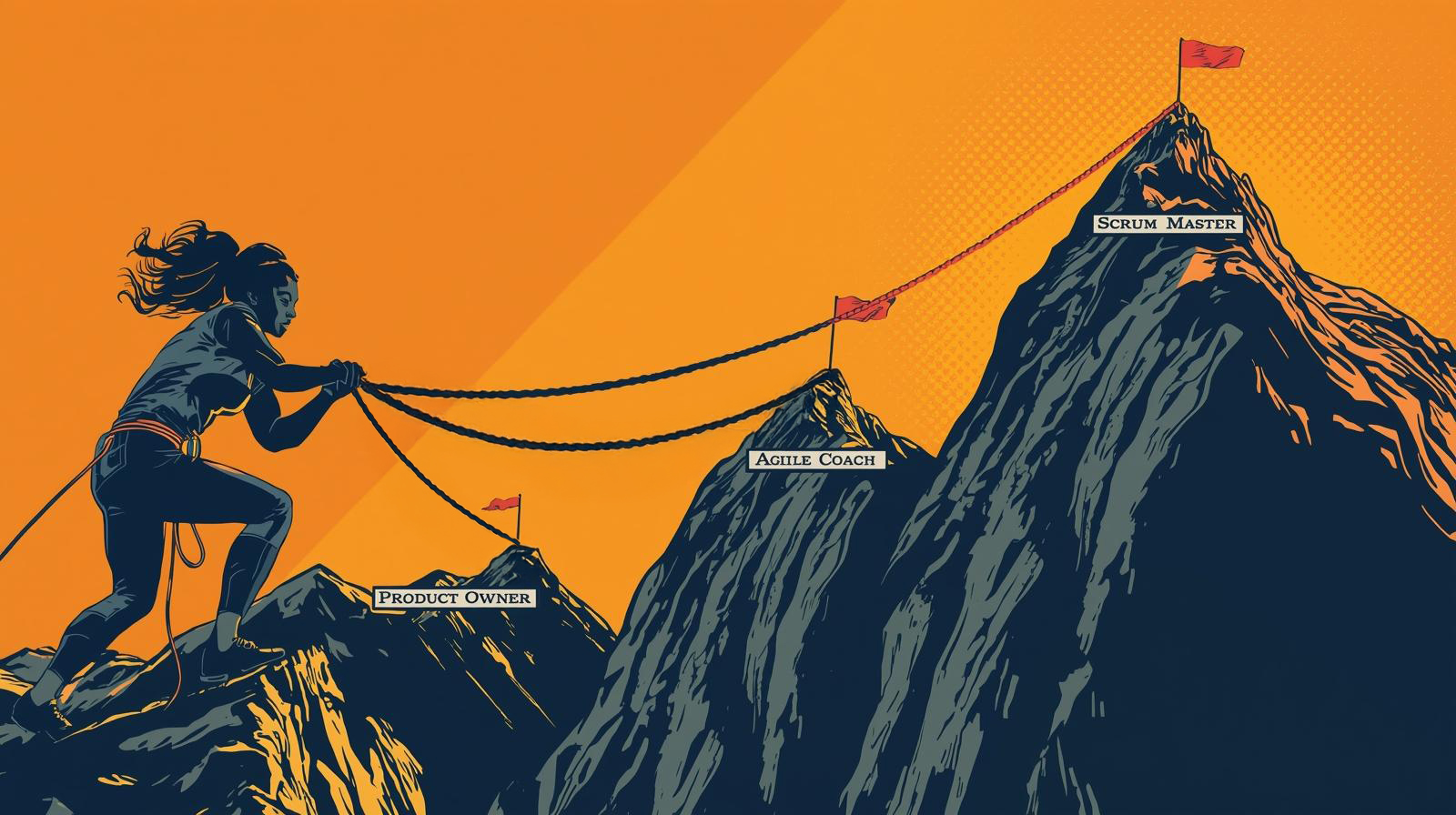
An infographic showing three distinct career paths originating from the core Agile roles: Product Owner, Scrum Master, and Developer.
The skills you've learned this week are the foundation for many rewarding careers. The three core Scrum accountabilities often lead to specialized roles. A Product Owner might grow into a Senior Product Manager or Head of Product. A Scrum Master can evolve into an Agile Coach, helping entire organizations transform. And Developers with a strong understanding of Agile principles are highly sought after for technical leadership roles like Team Lead or Solutions Architect.
BREAK & Group Formation

A coffee cup and a notebook on a wooden table, signifying a break for coffee and discussion.
Let's take our final break of the course. Use this time to connect with your final group members. When we return, we will discuss professional certification and review the key concepts from the entire week to prepare you for the final practical session.
PSM 1 Certification Overview
A crisp, digital certification badge with a prominent gold star, surrounded by text that reads 'Professional Scrum Master (PSM I).'
The Professional Scrum Master (PSM I)The Professional Scrum Master (PSM I) is a certification that validates your knowledge of the Scrum framework and its application. certification is a great way to demonstrate your understanding of Scrum and your commitment to professional development. The exam covers the Scrum Guide, the Scrum valuesThe five core values of Scrum: Commitment, Courage, Focus, Openness, and Respect. and principlesThe foundational beliefs of Agile, such as customer collaboration, responding to change, and delivering working software frequently., and the role of the Scrum Master. We recommend using official resources from Scrum.org for self-study and practice tests.
Preparing for the Afternoon Practical

A professional-looking folder containing three documents: a resume, a cover letter, and a printed screenshot of a digital project portfolio.
This afternoon is dedicated to building your Agile PM Portfolio. Your final task is to compile your group's artifacts from the week and write an individual Personal Reflection. This reflection is crucial: you must connect a key project management concept directly to a specific experience from the week's shuffled groups. The goal is to articulate your new skills in a way that you can use in your resume, cover letter, and future job interviews.