Day 4: Agile Adoption and Organizational Strategy
Scaling Agile and driving change beyond the team.
Recap & Connection
A cyclical arrow symbolizing the continuous flow and connection of concepts from one day to the next.
Welcome to Day 4! Yesterday, we focused on the core execution of a Scrum project—how to define, plan, and complete work within a Sprint. Today, we zoom out to the bigger picture: how to introduce these practices to an organization and measure their success. Let's quickly review the key execution concepts from Day 3:
- Backlog Management & User StoriesStructuring all project work in a Product Backlog and breaking it down into small, valuable User Stories using the INVEST model.
- Estimation, Capacity & VelocityUsing Planning Poker to estimate work (Story Points) and using historical data (Velocity) to plan a realistic amount of work for a Sprint based on team Capacity.
- The Agile Sprint & Scrum EventsExecuting work within a time-boxed Sprint that contains all key events: Planning, Daily Scrum, Review, and Retrospective.
- Definition of Done & The IncrementEnsuring quality with a shared Definition of Done, leading to a valuable, potentially releasable product Increment at the end of each Sprint.
Navigating Project Constraints

An infographic showing the six project constraints in a hexagonal pattern: Scope, Time, Cost, Quality, Resources, and Risk.
Every project operates within a set of limitations known as project constraintsThese are the limitations and risks that a project manager must manage to achieve the desired outcome.. The classic "iron triangle"The traditional model of project constraints, consisting of Scope, Time, and Cost. consists of Scope, Time, and Cost—changing one will impact the others. A successful project manager doesn't just complete the work; they skillfully balance these competing constraints to deliver the best possible value.
The Expanded Iron Triangle

An infographic showing the six project constraints (Scope, Time, Cost, Quality, Resources, Risk) arranged in a star or hexagonal shape, illustrating their interconnected nature.
While the traditional "iron triangle" focuses on Scope, Time, and Cost, modern project management recognizes a more complex reality. Three additional constraints are crucial for success: QualityThe degree to which a set of inherent characteristics fulfills requirements. It's about how good the final product is., ResourcesThe people, equipment, and materials needed to complete the project. Are the right resources available when needed?, and RiskAn uncertain event or condition that, if it occurs, has a positive or negative effect on a project's objectives.. Balancing all six of these interconnected factors is the true art of effective project management, especially in complex, fast-moving environments.
Implementing Value-Driven Delivery
A simple line graph with an upward-curving line labeled 'Value Delivered' on the Y-axis against 'Time' on the X-axis, illustrating continuous value delivery.
In Agile, "value" is more than just features; it can be risk reduction, efficiency gains, or increased revenue. Value-Driven DeliveryValue-driven delivery is a principle of agile development that focuses on delivering the highest value to the customer in the shortest amount of time. is a core principle that focuses on prioritizing and delivering the highest value work first. The Value RoadmapA value roadmap is a strategic document that communicates the high-level goals and initiatives of a product or project, and how they will deliver value to the customer and the business over time. helps teams to visualize and plan their work based on the value it will deliver, rather than on arbitrary deadlines.
Visualizing Success: The Value Roadmap
An infographic of a winding road with key milestones. Each milestone is marked not by a date, but by a specific value-based outcome, such as 'Launch MVP to gather user feedback' or 'Increase user retention by 10%.'
A Value Roadmap is a strategic document that shifts the focus from "what we are building" to "why we are building it." Unlike a traditional timeline that lists features and dates, a value roadmap prioritizes outcomes. It visually organizes work around specific goals (e.g., "Increase User Engagement") and the value those goals bring to the business. This approach provides clarity, aligns stakeholders, and empowers the team to make better decisions about how to deliver the most impactful results.
The Resistance is Real: Handling Organizational Roadblocks

An image of a broken metal chain link being repaired by a specialized tool, symbolizing the effort needed to fix broken organizational processes.
Adopting Agile can be a significant challenge, especially in large organizations. Common roadblocks include "fake Agile"Adopting the practices of Agile (like stand-ups) without embracing the underlying values of collaboration, flexibility, and customer focus., lack of management support, and misaligned incentives. The Scrum MasterThe Scrum Master is the team role responsible for ensuring the team lives agile values and principles and follows the processes and practices that the team agreed they would use. plays a crucial role as a change agentA change agent is someone who helps an organization to transform by focusing on such matters as organizational effectiveness, improvement, and development., helping the organization navigate these challenges. For more, see our guide on Conflict Resolution & Risk Management.
BREAK & Case Study Setup
A diverse group of people around a table, pointing at charts and diagrams, collaborating to solve a complex problem.
Let's take a short break. We've discussed the theory of handling organizational roadblocks. When we return, we will look at real-world case studies of Agile transformations. Think about the challenges we've discussed and how they might apply to different company cultures and industries.
Coaching an Agile Team: Servant Leadership

An infographic of a human brain with lobes labeled 'Coaching', 'Mentoring', and 'Teaching', representing the blended skillset of an Agile Coach.
An effective Scrum Master is a skilled coach, mentor, and teacher. They use these different stances to help the team to grow. CoachingCoaching is the art of facilitating the performance, learning, and development of another. involves helping the team find their own solutions, while mentoringMentoring is a relationship in which a more experienced person helps to guide a less experienced person. involves sharing experience. TeachingTeaching is the process of imparting knowledge and skills from a teacher to a student. is used to introduce new concepts. The goal is to empower the team to become self-managing and high-performing.
Measuring Success: Defining KPIs for Agile Adoption
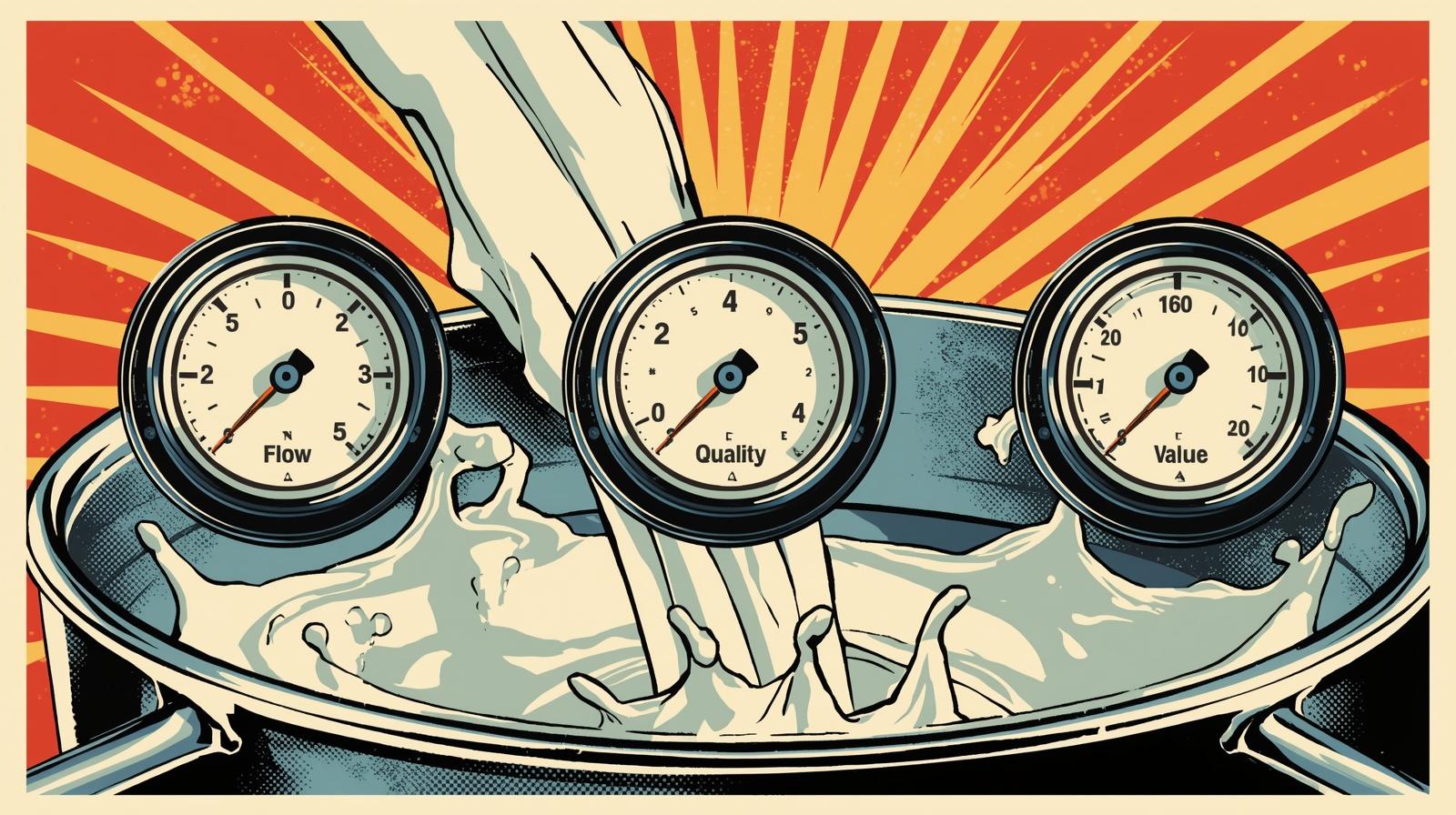
A digital dashboard with three gauges labeled 'Flow,' 'Quality,' and 'Value,' representing the measurement of success in an Agile adoption.
To demonstrate the benefits of Agile adoption, it's important to track the right metrics. Key Performance Indicators (KPIs)A Key Performance Indicator (KPI) is a measurable value that demonstrates how effectively a company is achieving key business objectives. for Agile should focus on outcomes rather than outputs. Instead of tracking lines of code, focus on metrics like cycle timeThe time it takes for a task to move from 'In Progress' to 'Done'. A key metric for team efficiency., defect densityThe number of confirmed defects identified in a component or system, which is a key measure of quality., and customer satisfactionA measure of how products and services supplied by a company meet or surpass customer expectation.. These KPIs provide a more accurate picture of the team's performance and the value they are delivering.
Kanban Metrics: Lead Time vs. Cycle Time
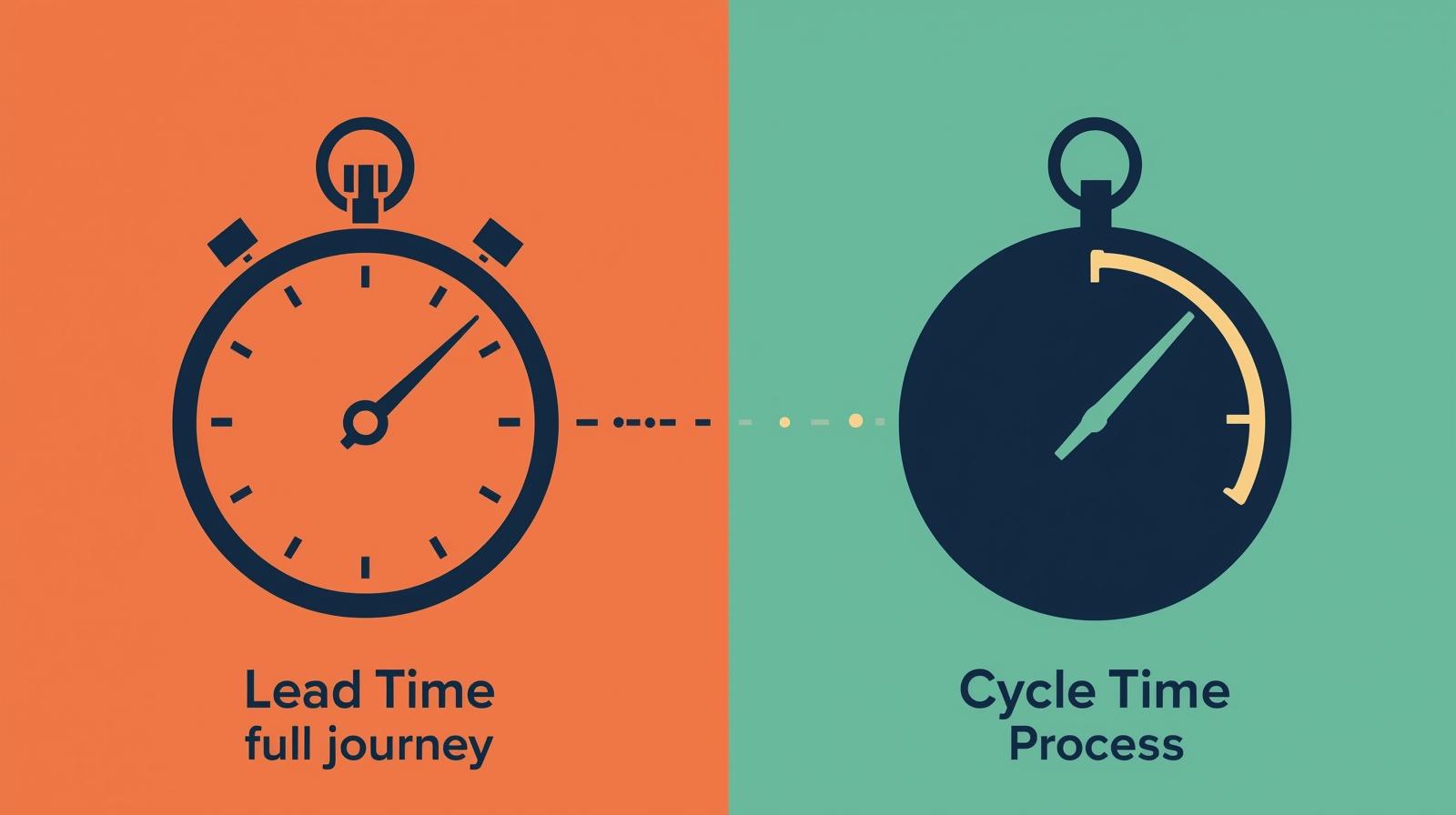
An infographic with a timeline. A dotted line represents Lead Time, starting from the customer's request and ending with delivery. A solid line represents Cycle Time, starting when the team begins working on the request and ending when it's completed.
Lead TimeLead time is the total time from the moment a request is made until it’s fulfilled. and Cycle TimeCycle time is the time it takes for a team to complete an item of work from the moment they start working on it. are two key metrics in Kanban. Lead Time is the total time from when a request is made until it is delivered, while Cycle Time is the time it takes to complete a task once work has begun. Cycle Time is a particularly important metric for the Developers, as it's a measure of their efficiency and predictability that is directly within their control.
The Evolving Frameworks: Scaling Agile

A digital graphic showing a small tree growing roots and branching out into a network of interconnected trees, illustrating scaling Agile.
As organizations grow, they often need to scale Agile beyond a single team. There are several scaling frameworksScaling frameworks are sets of principles and practices that allow multiple teams to work together in an agile way, such as SAFe, LeSS, and Nexus. available to provide guidance on how to coordinate the work of multiple teams, manage dependencies, and align everyone towards a common goal. However, scaling Agile also introduces new complexities, so it's important to choose the right framework for your organization's needs.
Scaling Framework: SAFe

A detailed infographic illustrating the different levels of the Scaled Agile Framework (SAFe), from the team level to the portfolio level.
The Scaled Agile Framework (SAFe)A set of organization and workflow patterns for implementing Agile practices at an enterprise scale. is a highly structured and prescriptive framework for large-scale Agile adoption. It organizes teams into "Agile Release Trains"A long-lived team of Agile teams, which, along with other stakeholders, incrementally develops, delivers, and operates one or more solutions in a value stream. and provides roles, events, and artifacts at multiple levels: TeamThe foundational level where Agile teams build and deliver value., ProgramThe level where teams of teams (Agile Release Trains) coordinate to deliver solutions., Large SolutionCoordinates multiple Agile Release Trains for building large and complex solutions., and PortfolioAligns strategy with execution and organizes the flow of value through one or more value streams.. SAFe is often chosen by large, complex organizations that require a significant degree of top-down alignment and governance.
Scaling Framework: LeSS
A simpler infographic showing how multiple Scrum teams can coordinate to work on a single Product Backlog in the LeSS framework.
Large-Scale Scrum (LeSS)A framework for scaling Scrum to multiple teams. It is based on the principle of applying the regular Scrum framework in a large-scale context. is a framework that aims to apply the principles of single-team Scrum to multiple teams working together on one product. It emphasizes simplicityIn LeSS, this means trying to solve problems with less, not more, organizational structure or process. and minimalismLeSS aims to apply simple Scrum principles to a multi-team context with as few new rules as possible., using the core Scrum eventsThe time-boxed events in Scrum that create regularity and enable inspection and adaptation. and rolesThe three accountabilities in a Scrum Team: Product Owner, Scrum Master, and Developers. as much as possible. LeSS is a good choice for organizations that want to scale Scrum without adding significant overheadIndirect costs or expenses (like extra meetings, roles, or artifacts) that are not directly productive but are required for coordination. or new roles.
Scaling Framework: Nexus
An infographic showing the Nexus framework, with a Nexus Integration Team coordinating the work of several Scrum teams around a single Product Backlog.
NexusA framework from Scrum.org for developing and sustaining scaled product and software development initiatives. It uses Scrum as its building block. is a framework from Scrum.org for scaling Scrum to multiple teams (typically 3 to 9) working on a single Product BacklogAn ordered list of everything that might be needed in the product. It is the single source of truth for all work.. It introduces a new role, the Nexus Integration Team, to coordinate the work of the individual Scrum teams and ensure that a single, integrated IncrementThe sum of all the completed Product Backlog items from a Sprint, representing a step toward a Product Goal. is produced at the end of each SprintA fixed-length period (1-4 weeks) during which the team works to create a "Done" product Increment..
Preparing for the Afternoon Practical
A person pushing against a large boulder that is blocking a road, symbolizing the effort to overcome organizational roadblocks.
This afternoon, you will step into the role of an Agile change agent. Your group's task is to analyze the specific organizational challenges in your project scenario and create a high-level Agile Adoption RoadmapA strategic plan that outlines the steps, communication, and metrics for guiding an organization toward a more Agile way of working.. This plan should outline the key steps, communication strategies, and metrics you would use to guide your organization toward a more Agile way of working. You will also simulate a Sprint RetrospectiveA meeting held at the end of a Sprint for the team to inspect itself and create a plan for improvements for the next Sprint. to identify one key process improvement for your team. For more, see our guide on Conflict Resolution & Risk Management.